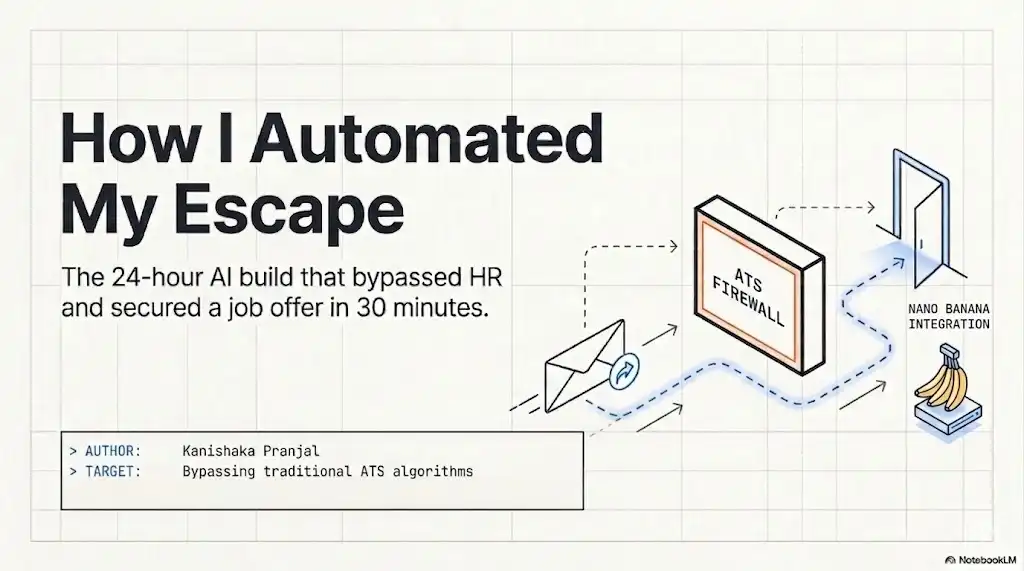
August 2025 was supposed to be a milestone, but honestly, it felt like a trap. I had just attended my graduation ceremony at IIIT Sri City, and while most of my friends were celebrating their shiny new offers, I was stuck.
I was grinding away at a low-paying internship, watching the reality of a heavy student loan loom over my head. Every single day, I played the same soul-crushing game: scroll through LinkedIn and Indeed, find a role, tweak the resume, hit apply, and throw my application into the void.
Nothing. No interviews. Not even a generic rejection email. Just complete, deafening silence. It was getting to the point where I didn’t even know if human eyes were looking at my resume anymore, or if algorithms were just quietly binning my life's work. The frustration was turning into a dark, heavy weight. I was standing right on the edge of depression.
The traditional system of "apply on the portal and wait" was fundamentally broken, and playing by its rules was getting me absolutely nowhere.
On August 13th, the frustration hit a boiling point. I decided to stop playing their game and build my own.
The 24-Hour Sprint & The Math of 60% Accuracy
If the front door was locked and the recruiters were ignoring me, I needed a way to automate breaking in through the side window. I locked in for a full-day sprint to build the AI Job Applicant Assistant.
I wanted an autonomous system that could find the jobs I actually wanted, hunt down the direct emails of the HR reps or founders, and dynamically draft hyper-personalized cold emails.
Building something like this in 24 hours comes with complications. Finding the correct email for a specific hiring manager is notoriously difficult. But as an engineer, you have to know when to trade the pursuit of 100% perfection for ruthless speed. The system’s email-finding accuracy hovered around 60-70%.
Was it perfect? No. The other 40% resulted in hard bounces or hit generic info@ company buckets. But hitting the right inbox 6 out of 10 times with an automated, highly targeted cold email is infinitely better than manually sending zero perfect ones.
Under the Hood: The 3-Click Architecture
I built the platform using React 19, TypeScript, Vite, and Google's GenAI SDK (Gemini 2.5 Flash). I heavily optimized the application for speed, cutting down the friction of ordinary job hunting. Sending a tailored application required exactly three clicks:
Click 1: The Intelligent Discovery
The application starts by analyzing my static resume and cover letter (hardcoded into constants.ts to act as the fundamental truth and prevent LLM hallucinations). It infers my preferences (Next.js, TypeScript, AI orchestration) and uses Gemini's web search to fetch 10 highly relevant recent job openings. Simultaneously, it fires background tasks to enrich missing HR emails, using Gemini to scrape web results first, then falling back to deterministic APIs like Clearbit and Hunter.io if the LLM fails.
Click 2: The 2-Step Generator & The Humanizer Agent
Recruiters can spot a ChatGPT-generated email from a mile away. To fix this, I built a dual-agent workflow:
Agent 1 (The Drafter): Generates a custom email specifically tailored to the intersection of my skills and the job's requirements.
Agent 2 (The Humanizer): Acts as the "Chief Editor." It explicitly evaluates Agent 1's draft against a rubric, checking for robotic phrasing, generic flattery, and "AI hallmarks." It transparently rewrites the content to ensure it reads like a genuine human application, strictly enforcing formatting like proper line breaks and explicitly injecting my portfolio URL.
Click 3: The Deployment
The system compiles the final draft Subject, Body, and 'To' fields directly into a mailto format. It tracks my session history in the browser's localStorage (so I never double-email a company) and opens the Gmail web interface prepopulated for final review and sending.
The HR Bypass: How It Actually Played Out
I fired off about 40 to 50 cold emails with this agent. I didn't know exactly how many were perfectly accurate or how many were opened, but I didn't need a 100% open rate. I just needed one to land.
Out of those 50 emails, two were routed to WeAssist.io.
- One went to the standard recruitment team.
- One went to the Executive Assistant of the founder.
The recruitment team completely rejected it. If I had just applied through their portal, my journey would have ended right there.
But the Executive Assistant read the "humanized" cold email, saw the value, and forwarded it directly to the founder. My interview got set up immediately.
When the call started, I knew I had a fragile window before we defaulted to abstract LeetCode trivia. I asked if I could share my screen. I pulled up FableWeaver.ai (the massive AI storytelling app I had spent 2,000 hours building on weekends), and showed them exactly how I solve complex engineering problems.
The standard hiring process at WeAssist.io takes 4 to 5 rounds. I was hired in 30 minutes on what was supposed to be my intro call.
That was the ultimate irony. The 24-hour automated script was exactly what kicked the door open. But it was the 2,000 hours I spent bleeding over code on the weekends that actually closed the deal. It wasn't about waiting for the perfect opportunity; it was about building a machine to force the opportunity to happen.
The Reality of Luck
Some people look at that 30-minute interview and call it luck. And honestly? I am lucky. But luck is just a numbers game, and I built an engine to roll the dice 50 times faster than anyone else.
People love to point at the finish line and call the winner lucky. They see the 30-minute job offer, but they don't see the 2,000 hours of unseen work, the constant fear of failure, or the weight of a student loan that made it possible. The dynamic between getting "lucky," outworking everyone else, and actually earning a role is something I've been thinking about a lot lately especially when even my own younger brother tells me how lucky I got. Taking control of that narrative changed everything.
But that is a story for another time. I’ll be diving deep into the actual math of "luck" and what it really means to be deserving in one of my future blogs.
Stay tuned.